

When used correctly, thrust bearings offer benefits that radial components cannot provide when subjected to axial loads:
High axial load-carrying capacity: Appropriately sized sliding thrust surfaces distribute loads across a large annular area, allowing them to withstand significant axial thrust without concentrating pressure. Heavy-duty thrust bearings are specifically engineered to endure the extreme axial forces encountered in demanding industrial environments, such as mining, construction, and material handling. Their robust design, hardened surfaces, and precision-ground finishes enable them to reliably absorb shock loads and maintain stable, long-term performance under the most rigorous operating conditions.
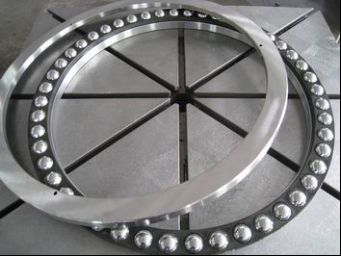
By providing precise axial positioning, these bearings secure the shaft's location, ensuring that gears, seals, and couplings remain aligned regardless of load variations. This is critical for maintaining the integrity of the assembly, as even minor axial displacement can lead to equipment failure or costly downtime.
Reduced wear and stable friction: A controlled sliding film or rolling interface minimizes metal-to-metal contact and the heat that causes surface damage. In heavy-duty thrust bearings, this is achieved through advanced micro-finishing techniques and carefully engineered oil-groove patterns, which optimize lubrication and heat dissipation across the load-bearing surfaces.
Impact resistance: Plain thrust bearing designs, in particular, are capable of absorbing intermittent thrust shocks-shocks that might otherwise cause Brinelling (indentation) in rolling-element bearings. This makes heavy-duty thrust bearings the preferred choice for applications prone to unpredictable loads or sudden reversals, thereby ensuring both reliability and extended equipment service life.
Manufacturing precision dictates the performance ceiling for all these advantages. Load-carrying capacity relies on surfaces that are perfectly flat and perpendicular to ensure uniform pressure; low friction depends on a smooth, consistent surface finish; and long service life is contingent upon the hardness and dimensional stability achieved through proper heat treatment and post-hardening grinding. It is in this regard that extremely tight tolerances and controlled surface finishes translate directly into reliability, rather than remaining merely as abstract technical specifications.
The range of specifications is equally important. As there are no uniform size standards for heavy equipment, industrial thrust bearings-available in sizes ranging from small collars to large-diameter bearing rings-can meet the precise requirements of original equipment manufacturers (OEMs) regarding bore diameter, face area, and groove configuration for their machinery. This flexibility allows a single supplier to fulfill thrust bearing requirements across an entire product line, sparing designers from having to make compromises based on existing, off-the-shelf inventory.