

In a crossed roller bearing, cylindrical rollers are arranged at a 90-degree angle to one another-separated by spacers-within V-shaped raceway grooves. Consequently, these bearings are capable of supporting multi-directional loads, including radial, axial, and moment loads. Their inner and outer rings feature a miniaturized, ultra-thin design, resulting in a compact overall profile. Furthermore, they possess high rigidity, making them ideally suited for applications such as the joints of industrial robots and rotating mechanisms, the central pivots of mechanical systems, robotic arms, precision rotary tables, medical equipment, calculators, integrated circuit manufacturing machinery, and similar devices.
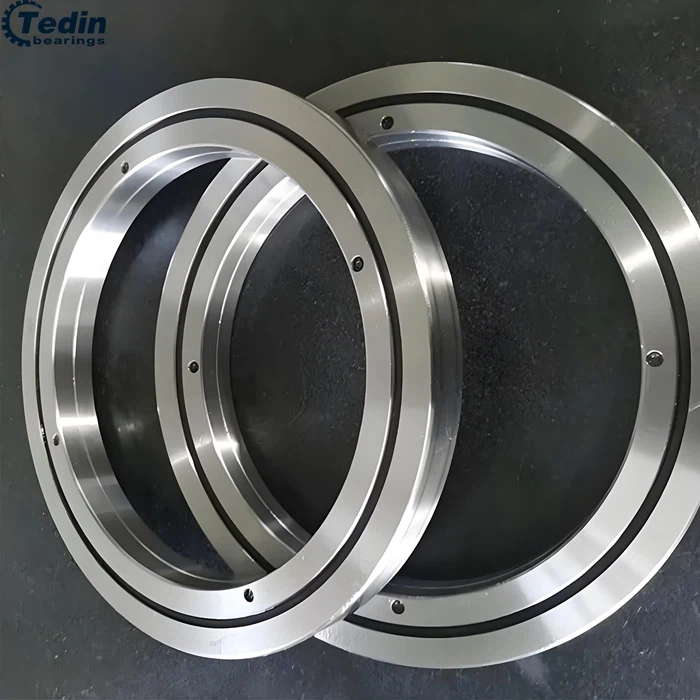
By utilizing a crossed arrangement of cylindrical rollers combined with separator spacers, the design effectively prevents roller skewing and mutual friction between rollers, thereby reducing rotational torque. Moreover, compared to bearings utilizing stamped steel cages, this design eliminates issues such as edge stress concentration and roller jamming. Additionally, thanks to a two-piece construction for either the inner or outer ring, the bearing clearance can be adjusted; this allows for high-precision and high-stability rotation to be achieved, even when a preload is applied.
Applications of High-Precision Crossed Roller Bearings
Machine Tools: Turret indexers, indexing tables, automatic loaders.
Robotics: Rotary joints, joint drive mechanisms.
Semiconductor Manufacturing Equipment: Handling robots, inspection platforms.
LCD Manufacturing Equipment: Handling robots, inspection platforms, photoresist coating roller drive units.
Printers: Photoreceptor roller drive mechanisms.