

Slewing bearings and cross-roller bearings share similarities in both function and structure-for instance, they both offer high rigidity, high precision, excellent bearing performance, and high rotational speeds. An increasing number of high-precision CNC machining devices-such as CNC indexing tables, vertical machining centers, and vertical grinding machines-are moving away from traditional designs to adopt the superior performance offered by high-precision cross-roller bearings and slewing bearings.
Differences Between Cross-Roller Bearings and Slewing Bearings
Advantages of Slewing Bearings:Structure:
Slewing bearings are also referred to as rotary bearings; some people use the terms "rotary bearing" and "slewing bearing" interchangeably. A slewing drive unit typically consists of a worm gear, a slewing bearing, a housing, a motor, and other components.
Installation:
Slewing bearings require the correct installation of rollers and spacers. Selected cylindrical rollers and circular spacers are placed along the raceway. When positioning adjacent cylindrical rollers, their axes must be mutually perpendicular, and a spacer must be placed between every two rollers.
Characteristics:
With the slewing bearing serving as its core component, the assembly is capable of simultaneously withstanding axial loads, radial loads, and overturning moments.
Applications:
Slewing bearings are primarily used in: truck cranes, railway cranes, port cranes, marine cranes, metallurgical cranes, container cranes, excavators, filling machines, CT stationary-wave therapy devices, navigation instruments, radar antenna bases, missile launchers, tanks, robots, rotating restaurants, and similar equipment.
Slewing bearings offer higher rigidity and lower operational noise levels compared to cross-roller bearings. Consequently, in high-precision, low-noise working environments, slewing bearings represent the superior choice.
Advantages of Cross-Roller Bearings
Structure:
The cross-roller bearing is a specialized type of bearing.
Installation:
Since the split inner or outer rings of a cross-roller bearing are secured by a cross-roller ring (retaining ring) after the rollers and spacers have been installed-thereby preventing the ring segments from separating-the process of installing the cross-roller bearing assembly is remarkably simple.
Features
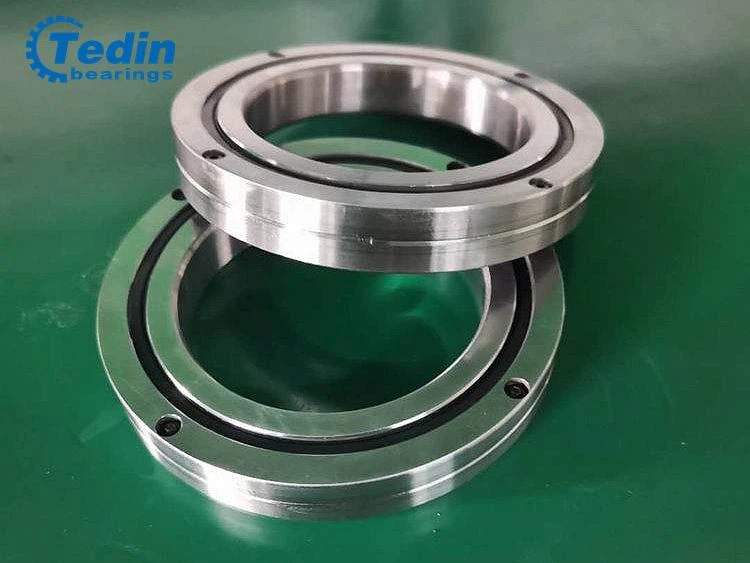
Due to the crossed arrangement of its rollers, a single crossed roller bearing is capable of supporting loads in all directions. Compared to conventional bearings, its rigidity is enhanced by a factor of 3 to 4.
Applications:
Crossed roller bearings are primarily used in: precision rotary indexing tables for machine tools; vertical and horizontal boring machines; vertical grinding machines; rotary surface grinders; large-scale gear hobbing machines; gun turrets and radar turntables; large radio and optical telescopes; rotary cameras; steering pivots and continuous casting machines; height-constrained rotary microscope stages; rod center pivots; rotary trolleys; welding fixtures; rotary assembly jigs; industrial robots; precision rotary tables; medical equipment; metrology instruments; and integrated circuit manufacturing equipment.
Furthermore, thanks to their high rotational efficiency and low heat generation, crossed roller bearings also require minimal grease consumption.