

Generally speaking, the vibration produced in the grinding process is a harmful phenomenon that destroys normal grinding. When the grinding speed is high and the amount of metal grinding is large, strong vibration is often produced. Due to the unreasonable structure of the equipment, the grinding wheel drive motor is installed on the small sliding frame, and the vibration source generated by the motor is transmitted to the grinding wheel through the small sliding frame. In the process of grinding, the crossfeed movement of the small carriage transmits the vibration to the roller through the grinding wheel, and the roller feeds back the vibration to the small carriage system, which further intensifies the vibration of the whole system. In the process of grinding, the vibration produced by the processing system directly affects the quality and productivity of the roller surface. If the vibration is not eliminated and suppressed in time in the process of semi-precision grinding and fine grinding, the surface of the roller must be mapped with a square wave vibration pattern.
The vibration source of roll grinder mainly comes from the following aspects:
(1) The main reason is that the grinding wheel drive motor is unbalanced and produces vibration.
(2) The grinding wheel does not balance dynamically and statically and vibrates when it rotates.
(3) The length or tightness of the V-belt drive is inconsistent, resulting in vibration.
(4) Vibration caused by uneven grinding force and uneven thickness of the metal grinding layer.
(5) If the lubrication effect of the support bracket is not good, or the lapping is in the form of a point or line, vibration will occur.
An effective way to eliminate vibration
There are three kinds of vibration. To eliminate the vibration in the grinding process, we need to start from three aspects: grinder, grinding wheel, and workpiece. The vibration of the processing system or grinder can be studied by grinding tests. At the same time, the grinding process can be controlled by changing the process parameters (such as grinding amount) which have an impact on the grinding process, so as to limit the generation of vibration.
Ways to eliminate forced vibration
The most effective way to eliminate forced vibration is to find out the external interference (vibration source) and remove it. If it can not be removed, the isolation method can be used. The grinding wheel drive motor is installed on the small sliding frame. Although the rubber pad is installed at the lower part of the motor base (increasing damping), there is no damping at the joint between the bottom plate and the upper cover plate of the small sliding frame. As the damping is too small, the vibration is not eliminated, and it is still conducted on the small carriage. The improvement measure is to install a rubber pad at the bottom plate and the upper cover plate of the small sliding frame to balance the motor precisely. Replace the drive motor belt to ensure its proper tightness and consistent length. In addition, the dynamic and static balance of the grinding wheel is adjusted to eliminate the centrifugal force produced by high-speed rotation.
Ways to eliminate self-excited vibration
(1) reasonable selection of parameters related to the grinding process
The feasible way in production is to determine the grinding amount by experiment. The grinding can be tested according to the initially selected grinding amount, and then the grinding amount can be adjusted accordingly until finally determined. In practice, the vibration of the wheel is observed as follows: when the linear speed V of the grinding wheel is in the range of 5-15m / s, the vibration is very slight; when V is in the range of 15-25m / s, the vibration is obvious, but it is relatively stable; when V is in the range of 25-30m / s, the vibration is intensified; when v = 35m / s, the vibration is severe. Therefore, according to the idling characteristics of the grinding wheel, the medium and low-speed grinding should be selected as far as possible in order to avoid self-excited vibration. Generally, 18-20m / S is better. As for the traveling speed of the large carriage, the amplitude decreases with the increase of the speed. When the speed is lower than 300 mm/min, the amplitude increases. Therefore, under the condition that the machining roughness requirement is permitted, the appropriate feed rate and 400-500mm / min for semi-fine grinding and fine grinding should be selected. And the speed adjustment is good when it is close to the end of the commutation point. Otherwise, when reversing, the speed changes suddenly, which is easy to produce creeping vibration. The operator generally selects 10-14r / min when the workpiece speed is in semi-fine grinding and fine grinding. According to the observation in practice, it is easier to appear transverse striation when using lower speed. The solution is to do the opposite. When n > 18rpm / min, the occurrence of cross striation can be effectively avoided by properly increasing the rotation number of the workpiece in the process of semi-fine grinding and fine grinding.
(2) In the process of semi-fine grinding and fine grinding, the cooling liquid with a proper high concentration of fine grinding fluid can also achieve a better vibration reduction effect.
(3) A proper grinding wheel is used to improve the anti-vibration performance. There are three main types of bonds for grinding wheel: ceramic, resin, and rubber. In terms of anti-vibration performance, the rubber bonded grinding wheel has the most obvious anti-vibration effect. The "Saint Gobain" grinding wheel, 23a60-lb24 (750 × 100 × 305), has been tried out. Its bond is thermosetting rubber, and its anti-vibration performance is obviously better than that of an ordinary ceramic grinding wheel.
(4) improve the positioning accuracy of the support roll
The positioning part of the support roll is two conical surfaces. If the two support necks do not coincide with the grinding machine center, the support roll will produce axial movement and radial runout in the process of rotation. Therefore, it should be carefully aligned to improve positioning accuracy. In addition, it should be noted that the floor screw of the neck frame should be tightened after alignment and positioning. If the positioning is not accurate, the roundness and coaxiality will be out of tolerance in the grinding process. The harm is that the rolling mill will run unstable, the thickness of the rolled strip will be uneven, the wave bending, convex and concave edges will not only seriously affect the product quality, but also reduce the service life of rolling roller bearings and other parts. Therefore, it is a problem that can not be ignored to control and detect the coaxiality of the roll body and roll diameter and the roundness of the roll body. In addition, manual glycerine lubrication is used for the lubrication of the neck bracket, and the lubrication effect is not good. According to this phenomenon, oil storage tanks can be opened on the bottom and side tiles of the neck frame to make the lubrication continuous and the oil film uniform, so as to ensure the stable rotation of the support roller. In the process of semi-precision grinding and fine grinding, because the measurement roll is often stopped, and when the workpiece is restarted after the measurement, the dynamic balance established previously will be changed due to the instantaneous starting torque. Therefore, it is better to measure the roller at low speed without stopping during the fine grinding. Or slow and uniform starting should be adopted during restart to prevent impact and ensure the dynamic balance does not change. Moreover, after 2-3 passes of semi-finish grinding, the stable grinding surface can be obtained.
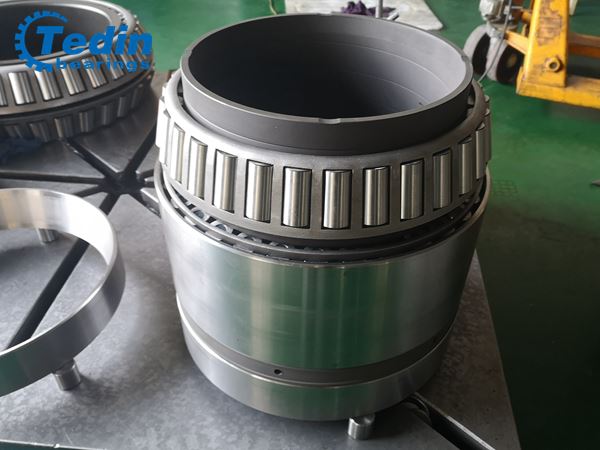
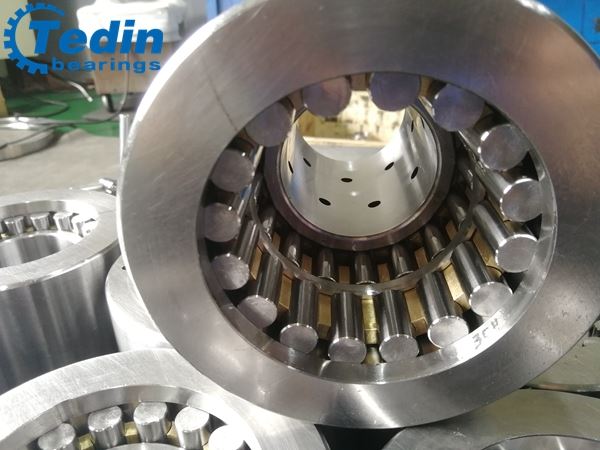
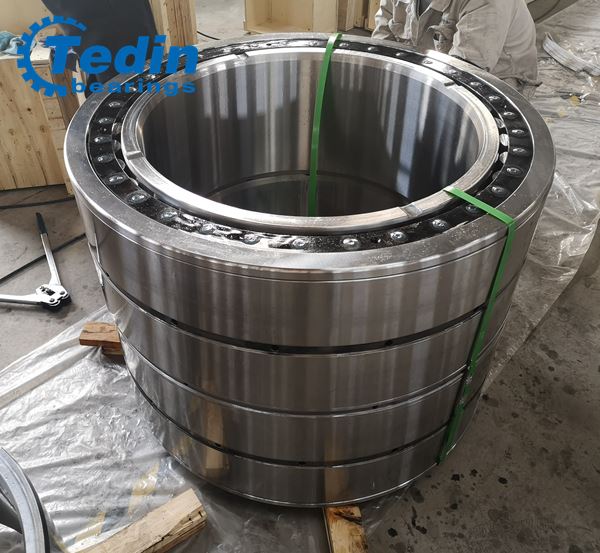
TEDIN produce backup roll bearings for rolling mills:
Check more models of Backup Roll Bearing
Check more models of Sendzimir Bearings
Check more models of bearings for rolling mills
Please check the Product Guide to select suitable bearings for your machinery.
E-mail: sales@tedin-bearing.com